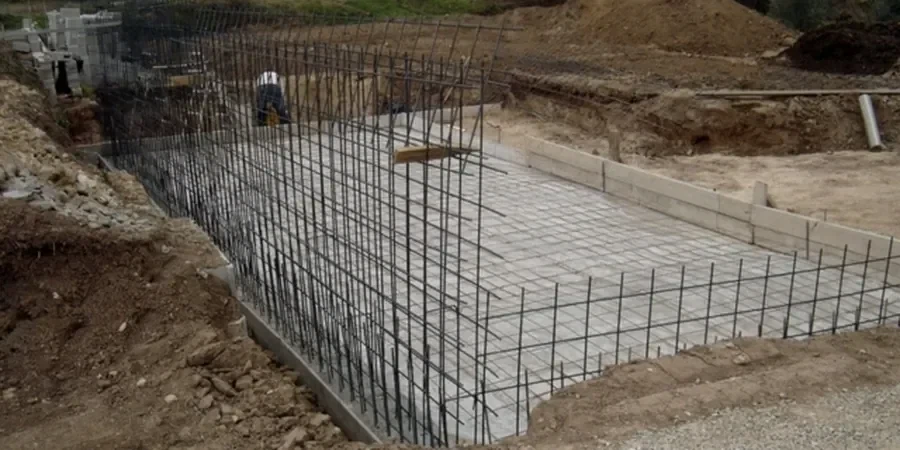
Specifying a footing depth based on a generic soil report from a distant suburb remains a common cause of post-construction cracking across the ACT. Canberra sits on the Silurian Canberra Formation—a mix of steeply dipping mudstone, siltstone, and volcanic tuff—mantled by highly reactive residual clays that can shrink or swell by over 60 mm between wet winters and dry summers. A shallow foundation design here has to reconcile two opposing demands: enough embedment to bypass the active moisture zone while staying above fractured rock where groundwater perched in joints can soften the bearing stratum overnight. Our team runs site-specific investigation programs that feed directly into bearing capacity models calibrated for the Pialligo siltstone and the Ainslie volcanics, so the final pad or strip footing specification reflects the actual stratigraphy under the cut, not just a regional map. When the upper profile shows colluvium thicker than 1.5 m, we often pair the footing design with a test pit program to log the depth to intact rock and with Atterberg limits testing to quantify the shrink-swell potential of the clay fraction before setting the founding level.
A footing on Canberra’s reactive clay can lose 30 to 40 percent of its bearing capacity within two seasons if the moisture regime around the foundation isn’t controlled.
Regional considerations
The weathered profile across the ACT can transition from stiff residual clay to highly fractured, moderately weathered rock within a vertical metre, and water moving through open joints in the underlying tuff creates localised softening that bearing equations alone won’t capture. A footing placed on what appears to be competent material during a dry February excavation can lose 40 percent of its ultimate bearing capacity by July when seasonal perched water rises. Then there is the differential heave risk: on a sloping block in suburbs like Aranda or O’Malley, a cut-and-fill platform puts the uphill footing on near-intact rock and the downhill footing on compacted fill, producing differential movements that exceed the 10 mm serviceability threshold within the first two years. We address this by mapping the depth to engineering rock at every column location, specifying a consistent founding stratum across the entire footprint, and recommending subsoil drainage where groundwater monitoring shows a perched water table within 1.5 m of the underside of the footing.
Q&A
What bearing pressure can I expect for a pad footing on weathered Canberra mudstone?
For moderately weathered, low-strength mudstone typical of the Canberra Formation, we commonly adopt allowable bearing pressures between 300 and 600 kPa for isolated pad footings under permanent load, applying a factor of safety of 3.0 in accordance with AS 4678. The final value depends on the rock’s fracture spacing, the RQD from the borehole log, and the inclination of bedding planes relative to the load axis.
How deep do footings need to go in Canberra’s reactive clay areas?
Embedment depth is determined by the site’s AS 2870 classification and the Thornthwaite moisture index for the ACT. Most Class M to H1 sites in suburbs like Kaleen or Weston require a minimum embedment of 450 to 750 mm below the finished surface level, with deeper edge beams where significant cut-and-fill has altered the natural moisture profile.
What does a shallow foundation design package cost for a typical Canberra residential block?
For a single residential block requiring a site investigation, AS 2870 classification, and a signed footing design report, the package generally falls between AU$2.750 and AU$5.400 depending on the number of boreholes, the laboratory testing suite, and whether the site sits on uncontrolled fill that demands deeper investigation.