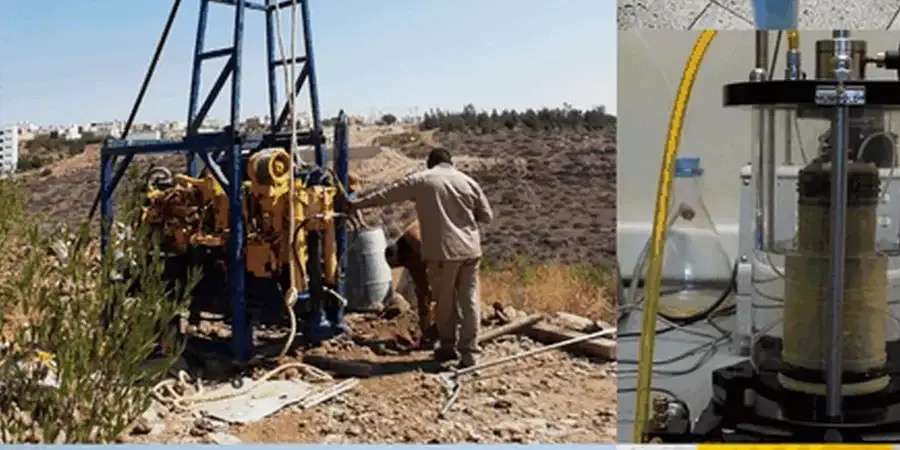
A split-spoon sampler driven into weathered Canberra siltstone tells you more than a dozen desktop reports. The city sits on a complex interface between the Canberra Formation and Quaternary alluvium, which means a proper soil mechanics study here has to account for abrupt transitions from stiff residual clay to highly fractured bedrock within a single borehole. Our technical team runs consolidated undrained triaxial tests and one-dimensional consolidation on Shelby tube samples extracted across Belconnen, Tuggeranong, and the Inner North, where the geology can change in less than fifty metres. The lab operates under NATA accreditation with constant-temperature curing rooms and automated cyclic triaxial cells for liquefaction screening in saturated alluvial pockets near Lake Burley Griffin. Every sample gets logged against AS 1726:2017 descriptors for consistency, structure, and weathering grade.
Canberra's residual clays can exhibit apparent preconsolidation pressures that mask their true settlement potential under sustained loading.
Q&A
What does a soil mechanics study in Canberra typically cost for a single residential block?
For a standard residential lot in the ACT with two boreholes to six metres depth plus laboratory testing, the fee generally falls between AU$4,600 and AU$8,060 depending on access conditions, the number of samples tested, and whether rock coring is required through the Canberra Formation.
How deep should the boreholes go for a soil mechanics study on a Canberra site?
The minimum depth under AS 1726 is the zone of stress influence, typically 1.5 to 2 times the footing width. In Canberra's reactive clays we often extend to 6-8 metres to capture the full weathered profile and confirm refusal in Class IV or better rock, which provides a reliable bearing stratum.
Do I need a soil mechanics study for a Class A or Class S residential slab in the ACT?
Yes. The ACT variation to AS 2870 requires site classification based on actual soil testing, not desktop mapping alone. A soil mechanics study provides the Ys reactivity value and the site classification letter that the structural engineer needs to design the slab stiffening beams correctly.
How long does the laboratory testing phase take?
Standard classification testing and unconfined compression run about seven to ten working days. Consolidation and triaxial testing add another ten to fifteen working days because of the time needed for staged loading and pore pressure equalisation in Canberra's low-permeability clays.
Can the soil mechanics study be used directly by the structural engineer?
Absolutely. The report is written as a design-input document with bearing capacity recommendations, settlement predictions under both dead and live load, lateral earth pressure coefficients for retaining walls, and site classification to AS 2870. The parameters are formatted so they copy directly into structural modelling software.