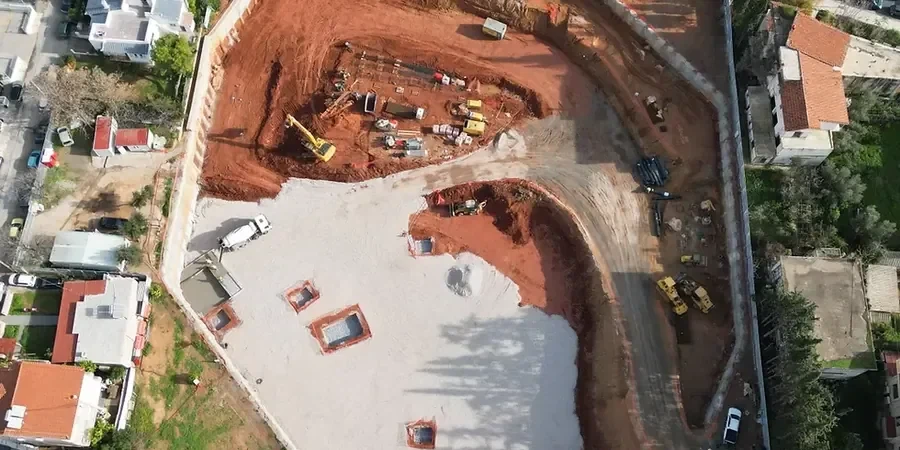
Canberra’s geology demands a rigorous approach to deep excavation design. Our work follows AS 1726 and AS 4678, and we tailor every design to the specific ground conditions found across the ACT. Much of the city sits on the Canberra Formation—steeply dipping, weathered siltstone and sandstone that behaves unpredictably once you open a cut more than a few metres deep. One day you’re in stiff residual clay, the next you hit a fractured rock band with water seeping through joint sets. Add the local topography and proximity to Lake Burley Griffin, and groundwater becomes a controlling factor, not an afterthought. Before finalising shoring layouts, we often run an in-situ permeability test to calibrate dewatering assumptions, and for projects near the Molonglo River corridor we combine that with slope stability analysis to guard against broader excavation-induced movements. With over 450,000 residents and a growing number of multi-level basement constructions in Civic and Braddon, getting the geotechnical parameters right from the first borehole makes the difference between a predictable dig and a reactive, costly one.
Canberra’s weathered siltstone can look like rock until you expose it to air and water—then it behaves more like a cemented soil.
Regional considerations
Canberra’s planned urban form dates back to Walter Burley Griffin’s 1913 design, but the city’s underground infrastructure only started deepening significantly in the last thirty years. Many older buildings in Civic were constructed with shallow footings, and today’s deep excavations for new basements and light rail infrastructure are cut within metres of those sensitive neighbours. Vibration from rock hammers, dewatering-induced settlement, and lateral wall deflection can all cause damage claims if not properly managed from the design phase. The weathered Canberra Formation is particularly prone to relaxation; once the confining stress is removed, clay seams within the siltstone open up and water ingress accelerates softening. We build observational method protocols into every design, setting trigger levels for movement and pore pressure so the contractor knows exactly when to step up support or switch to a more conservative excavation sequence. Geotechnical risk in Canberra is not about catastrophic collapse—it’s about cumulative millimetres of movement that become a legal headache and a project delay.
Q&A
What is the typical cost range for geotechnical design of a deep excavation in Canberra?
Fees for deep excavation geotechnical design in Canberra typically fall between AU$3,190 and AU$14,340, depending on excavation depth, shoring complexity, groundwater conditions, and whether construction-phase monitoring review is included.
Which Australian standards apply to deep excavation design?
The primary standards are AS 1726 for site investigation and AS 4678 for earth-retaining structures. We also reference AS/NZS 1170 for structural design actions and relevant sections of AS 5100 when the excavation is adjacent to road bridges or involves cut-and-cover tunnel elements.
How do Canberra’s ground conditions affect deep excavation design?
Much of central Canberra sits on the weathered Canberra Formation—interbedded siltstone and sandstone that transitions rapidly from soil-like to rock-like behaviour. Joint-controlled block failure, groundwater seepage along bedding planes, and rapid strength loss upon exposure all influence the choice of retention system and the sequencing of excavation and support installation.
What monitoring is required during deep excavation in the ACT?
We typically specify inclinometers behind the shoring wall, survey prisms on adjacent buildings and footpaths, vibration monitors if rock breaking is planned, and standpipe or vibrating-wire piezometers where groundwater drawdown could affect neighbouring properties.