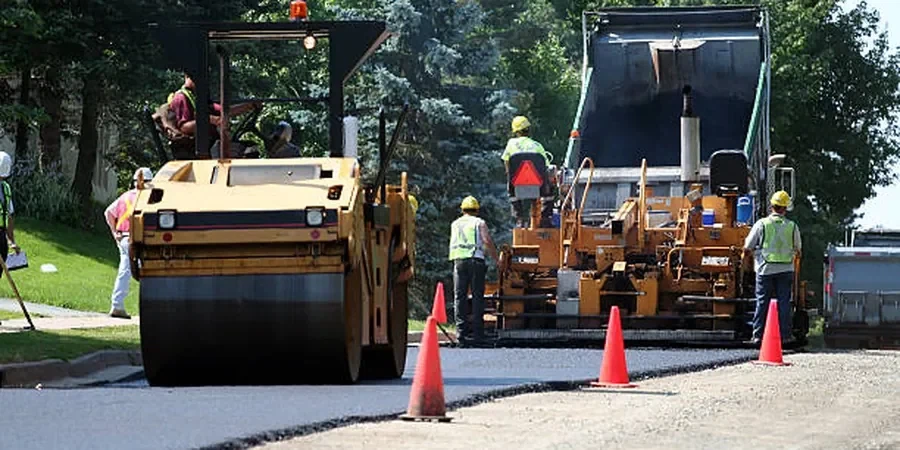
Canberra sits at approximately 580 metres above sea level, and its inland climate delivers frosty winter mornings followed by summer days that can push past 40 degrees. That thermal range, combined with the region's notoriously reactive Quaternary alluvium and residual clay soils, places extraordinary demands on road pavements. A pavement structure designed without accounting for these local conditions will show distress within just a few seasonal cycles. Our approach to flexible pavement design starts with a detailed geotechnical investigation of the natural subgrade — its stiffness, moisture sensitivity, and long-term behaviour under repeated traffic loading. We apply the CBR road testing protocol to quantify bearing capacity directly, often supplementing it with grain size analysis to characterise fines content and drainage potential before selecting the appropriate granular layer thicknesses. Working across Belconnen, Tuggeranong, and the light-industrial corridors of Fyshwick and Mitchell, the team has built a practical understanding of how local soil profiles respond to compaction, saturation, and the cyclic stresses imposed by Canberra's growing freight and commuter traffic volumes.
A flexible pavement is only as durable as the subgrade it rests on — and in Canberra, that subgrade can lose over half its bearing capacity between dry summer and wet winter conditions.
Method and coverage
On many Canberra project sites we observe that the natural subgrade exhibits a California Bearing Ratio below 5%, particularly in areas underlain by deeply weathered Silurian volcanics or expansive clay deposits derived from the Canberra Formation. A flexible pavement constructed directly on such material without adequate capping or stabilisation will rut within the first wet season. The design process follows Austroads Part 2: Pavement Structural Design, but the real value lies in how the geotechnical model is built before the mechanistic analysis begins. We characterise each layer — subgrade, selected fill, sub-base, and base course — through in-situ density testing with the
sand cone method and laboratory evaluation of compaction characteristics via
Proctor tests. Resilient modulus estimates are correlated from repeated load triaxial data where project scale justifies it, but for most arterial and local road projects the CBR-based empirical method remains the most cost-effective and reliable pathway when underpinned by rigorous sampling and strict moisture-conditioning protocols. The granular layer coefficients are then adjusted to reflect the actual material source, not just a generic quarry specification, which makes a measurable difference in long-term performance under Canberra's variable groundwater conditions.
Q&A
What is a flexible pavement and how does it differ from a rigid pavement?
A flexible pavement distributes traffic loads through a layered system where each layer transmits stress to the one below — typically an asphalt or spray-seal surface over granular base and sub-base courses. Unlike rigid pavements, which rely on the flexural strength of a concrete slab, flexible pavements depend on the bearing capacity of the subgrade and the confinement provided by the granular layers. In Canberra's reactive soils this means the subgrade preparation and drainage design are critical, because a flexible pavement cannot bridge weak spots the way a reinforced concrete slab can.
How much does a flexible pavement design investigation typically cost in Canberra?
For a standard residential street or access road project in the ACT, the combined geotechnical investigation and pavement design package generally falls between AU$2,970 and AU$8,540 depending on the length of the alignment, the number of test locations required, and whether laboratory resilient modulus testing is included. A site-specific quote is always provided after reviewing the project scope and traffic loading requirements.
What CBR value is considered acceptable for a flexible pavement subgrade?
A CBR of 5% or higher is generally considered workable for light to moderate traffic, but many Canberra sites test below that threshold in their natural state. When subgrade CBR falls below 3-4% we typically recommend either a thicker granular capping layer, lime or cement stabilisation of the upper subgrade, or geosynthetic reinforcement at the subgrade-sub-base interface. The Austroads design charts provide thickness adjustments based on the actual measured CBR, so there is no single pass/fail number — the pavement cross-section is simply engineered to match the ground conditions.
Does flexible pavement design need to account for Canberra's frost conditions?
Yes. While Canberra does not experience the deep frost penetration seen in alpine regions, overnight frosts during winter months can affect the upper 100-200 mm of the pavement structure. Frost-susceptible silty subgrades may heave slightly, and more importantly, the thaw period can temporarily reduce subgrade strength. Our designs incorporate a drainage layer and non-frost-susceptible granular material specifications to mitigate these effects, consistent with Austroads guidance for cool inland climates.