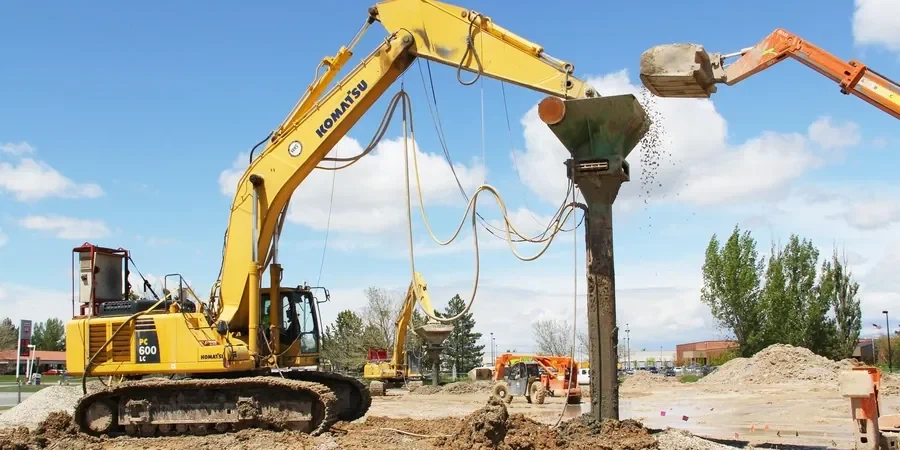
Ground improvement in Canberra encompasses a suite of geotechnical techniques designed to enhance the engineering properties of soil and fill materials, ensuring they can safely support structural loads and resist settlement. In a city defined by its planned urban landscape and expanding infrastructure, the role of ground improvement is critical. Canberra's development, from new residential suburbs in Molonglo Valley to major public infrastructure projects, frequently encounters variable and often challenging ground conditions. This category covers the assessment, design, and execution of methods that transform weak or compressible ground into a reliable foundation medium, mitigating risks associated with differential settlement, liquefaction, and bearing capacity failure. A robust understanding of these techniques is fundamental for developers, civil engineers, and architects operating in the Australian Capital Territory.
The local geology of Canberra presents a specific set of challenges that make ground improvement not just an option, but a necessity for many projects. The region is underlain by complex geology, including deeply weathered bedrock, transported clayey silts, and areas of loose alluvial and colluvial deposits along the Molonglo and Murrumbidgee river corridors. These natural soils are often intermingled with uncontrolled fill from decades of urban expansion. A common and problematic feature is the presence of highly reactive clay soils, which are prone to significant shrink-swell movement with seasonal moisture changes. This geological setting dictates the selection of appropriate improvement strategies, as standard shallow footing solutions are often inadequate for the ground's inherent variability and potential for movement.
All ground improvement design and construction in Canberra must strictly adhere to national and local regulatory frameworks, with the National Construction Code (NCC) serving as the primary document. The relevant Australian Standards are paramount, particularly AS 2870 for residential slabs and footings, which directly addresses reactive clay sites, and AS 2159 for piling design and installation. For deep ground treatment methods like stone column design, AS 4678 for earth-retaining structures and the general principles of geotechnical investigation outlined in AS 1726 are applicable. Furthermore, the ACT Territory Plan and associated codes, enforced by the ACT Environment, Planning and Sustainable Development Directorate, impose specific requirements for site classification, cut and fill management, and stormwater control, all of which are directly influenced by ground improvement decisions.
The types of projects requiring ground improvement in Canberra are diverse, ranging from detached housing on reactive clay sites to large-scale civil infrastructure. Residential subdivisions often necessitate the bulk treatment of expansive soils using lime stabilisation or the installation of stiffened raft slabs with deep edge beams designed for extreme site classifications. Commercial and multi-storey developments on former industrial land or near waterways frequently employ vibrocompaction design to densify loose granular soils, increasing bearing capacity and preventing liquefaction. Infrastructure projects, such as road embankments and bridge approaches over soft alluvial ground, rely on techniques like stone columns, wick drains, and controlled modulus columns to accelerate consolidation and provide structural load transfer. Each project demands a site-specific geotechnical investigation to characterise the ground profile and inform the most technically sound and cost-effective improvement methodology.
The most common techniques for reactive clays include chemical stabilisation with lime or cement to reduce plasticity and shrink-swell potential, and the construction of stiffened raft slabs with deep edge beams and internal stiffening ribs designed in accordance with AS 2870. For deep-seated movement, bored pier and beam systems or structural slabs on screw piles are also frequently used to isolate the structure from the active soil zone.
A comprehensive geotechnical investigation, following AS 1726, is the critical first step. It identifies the soil profile, depth to bedrock, groundwater conditions, and the classification of reactive clay sites. This data directly determines whether shallow soil mixing, deep vibrocompaction for loose sands, or load-transferring elements like stone columns are required, ensuring the chosen method addresses the specific depths and properties of the problematic soil layers.
The primary standard is AS 2870, 'Residential slabs and footings.' This standard classifies sites based on soil reactivity and expected characteristic surface movement, dictating the design and detailing of footing systems. The ACT Territory Plan also enforces compliance with this standard, and any alternative ground treatment must be certified by a qualified geotechnical engineer to meet the performance requirements of the National Construction Code.
Yes, when designed correctly, methods like vibrocompaction, stone columns, or surcharge preloading with vertical drains can effectively mitigate settlement risks. These techniques densify the soil mass, accelerate primary consolidation, and provide a composite ground with enhanced stiffness. The goal is to manage both total and differential settlements to within tolerable limits for the proposed structure, as defined by the project's performance specifications.