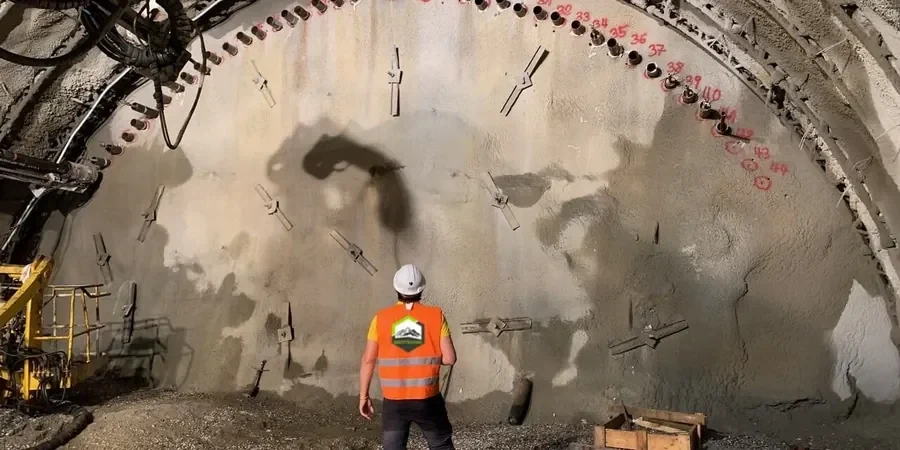
A multi-level excavation off Northbourne Avenue encountered completely weathered Canberra Formation siltstone at 4 metres. The contractor needed real-time confirmation that the temporary battered faces were holding as modelled. That’s where systematic monitoring stops being a checkbox item and becomes the primary risk control. In Canberra, the transition from residual clay to highly fractured rock can shift across a single bench, and pore pressure response after a summer storm often surprises teams relying solely on desktop assumptions. We deploy vibrating-wire piezometers, inclinometer casings and automated total stations to track lateral movement, groundwater fluctuation and surface settlement through the full cut sequence. The dataset feeds directly into observational-method decisions, which AS 4678 explicitly permits when instrumentation confirms behaviour stays within predefined trigger thresholds.
Monitoring transforms excavation from a predicted sequence into a verified performance record, with instrumented trigger levels replacing guesswork under AS 4678 observational frameworks.
Method and coverage
Canberra’s diurnal temperature swing, often exceeding 15°C between dawn and mid-afternoon during autumn, introduces thermal drift in unshielded inclinometer readings that can mask genuine ground movement. Our field crews compensate with paired temperature sensors and baseline readings taken at consistent pre-dawn intervals, a protocol refined across projects in Belconnen and Woden where cold-junction effects were distorting early datasets.
The monitoring plan typically combines three measurement streams: subsurface lateral displacement via in-place inclinometers, pore-water pressure from push-in piezometers installed below excavation subgrade, and 3D prism surveys on retained facades adjacent to the cut. We cross-reference displacement vectors with
CPT pore pressure dissipation tests run before bulk excavation begins, so that consolidation-driven settlement can be separated from structural movement. For cuts deeper than 6 metres in the Canberra Formation, where stress relief can open pre-existing joint sets, crack meters on adjoining footpaths and services provide an additional early-warning layer.
Regional considerations
Canberra’s sedimentary geology introduces a specific monitoring challenge: the Canberra Formation contains montmorillonite-rich clay seams that swell when unloaded and wetted, producing heave rather than settlement at the base of deep cuts. AS 4678-2002 requires that monitoring plans account for this reversal, yet standard specifications often overlook it until floor slabs show unexpected cracking. We embed heave points at formation level immediately after final trim, taking daily readings during the window between exposure and blinding concrete placement. On a recent Phillip commercial project, the data captured 18 mm of heave over four days following a 22 mm rain event, triggering a design review that added a compressible void-form layer before the raft pour. Without that instrumentation, the swelling pressure would have transferred directly into the completed structure.
Q&A
What is the typical cost of geotechnical excavation monitoring for a basement dig in Canberra?
Instrumentation and monitoring costs for a typical Canberra basement excavation range from AU$1,200 to AU$4,460 depending on the number of inclinometer strings, piezometer stations and survey points, plus the duration of the monitoring period and reporting frequency.
What does AS 4678 require in terms of monitoring trigger levels?
AS 4678 requires that serviceability and ultimate limit state trigger values be established before excavation begins, typically expressed as a percentage of excavation depth (commonly 0.1% for lateral movement) or a rate of displacement (e.g., 2 mm/week). Exceedance triggers a predefined response, which may include increased reading frequency, design review, or implementation of contingency measures.
How do you separate thermal effects from real ground movement in inclinometer data?
The reference range for this service in Canberra is AU$1.200 - AU$4.460. The final price depends on the project scope and volume.
Can monitoring data be used to justify design changes during excavation?
Yes. The observational method under AS 4678 explicitly allows design modifications based on instrumented performance, provided that trigger thresholds are predefined in the monitoring plan and that the design review is undertaken by the original design engineer. We supply weekly interpretation reports formatted specifically for observational-method decision meetings.