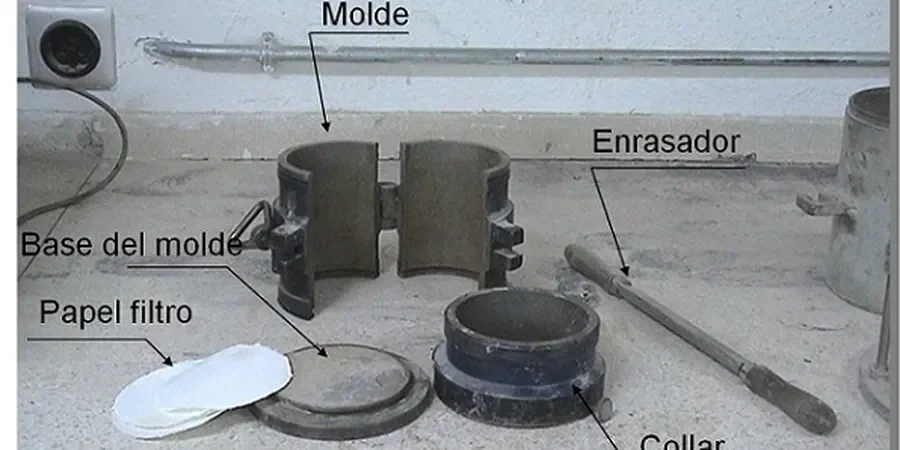
In Canberra's variable geology, from decomposed granite in Belconnen to the silty clays of the Molonglo Valley, moisture control during compaction makes or breaks an earthwork spec. Too dry and the fill won't densify; too wet and you get pumping and shear failure under the roller. We run the Proctor test because the contractor on the ground needs a clear, repeatable target: a single maximum dry density and an optimum moisture percentage to hit with every lift. The test itself is straightforward in principle—compacting soil in a standard mould at several moisture contents—but the local material often surprises. The weathered Canberra dacite can hold moisture differently than the alluvial deposits near Lake Burley Griffin, so we calibrate each borrow source individually. For deeper stratigraphic profiling before bulk earthworks, we often recommend a site walkover with test pits to identify material zones and sample each horizon for the lab.
A Proctor test done on Canberra's weathered dacite can shift optimum moisture by 2% across one borrow pit. Generic curves don't work here.
Method and coverage
Canberra's climate swings from dry, hot summers to frosty winter mornings, and that thermal range directly impacts field compaction timing. A Proctor curve developed in the lab at 20°C still holds, but the site team needs to account for evaporation losses on a 35°C January day or moisture lock-up when overnight temperatures dip below zero in July. We perform both Standard and Modified effort tests to AS 1289.5.1.1 and AS 1289.5.2.1, matching the compactive effort to the project specification. Standard effort (596 kJ/m³) typically applies to residential fill platforms and landscaping, while Modified effort (2700 kJ/m³) is specified for arterial road subgrades, heavy-duty pavements in the Hume industrial precinct, and structural fill beneath multi-storey footings. Each test delivers a compaction curve, a clear peak, and a target moisture window that the field crew uses for nuclear gauge or sand replacement density testing.
Regional considerations
A five-storey mixed-use project in Woden imported fill from a quarry near Pialligo. The spec called for 98% Modified Proctor density under the raft slab. The contractor placed the first two lifts without lab curves, assuming a standard moisture content from a previous job. Proof rolling showed excessive deflection, and field density tests came back at 89% to 91%. We tested the actual delivered material and found the optimum moisture was 2.3% higher than assumed—the clay fraction in the Pialligo source was holding more water. The contractor scarified, reconditioned, and recompacted the entire pad. Delays cost three weeks. With a Proctor curve in hand before the first truck tipped, that three-week rework would have been avoided. In Canberra, fill material varies between suburbs separated by only five kilometres. Testing each source before mass earthworks is the only safe approach.
Q&A
What does a Proctor compaction test cost in Canberra?
Standard Proctor testing typically ranges from AU$150 to AU$250 per sample depending on material type and preparation effort. Modified Proctor tests run between AU$220 and AU$360 per sample. If you need multiple borrow source curves for a large subdivision, we provide volume pricing. Contact the lab with your specification and number of sources for a firm quote.
How long does a Proctor test take to get results?
A standard Proctor curve with full moisture-density relationship is typically reported within 24 to 48 hours from sample receipt. Same-day results are possible when material is delivered to the lab early morning and the project is on a tight schedule. Oven-drying for moisture determination is the step that sets the minimum turnaround, but we run multiple points in parallel to compress the timeline where possible.
Which Proctor effort do I need for a driveway or residential slab in Canberra?
Most residential slabs and driveways in the ACT are specified under AS 3798 with a 95% Standard Proctor density requirement. However, if the slab is for a multi-storey building or located on fill deeper than 600 mm, the structural engineer may specify Modified effort. We always recommend checking the geotechnical specification before sampling, and we can advise once we see the project documents.