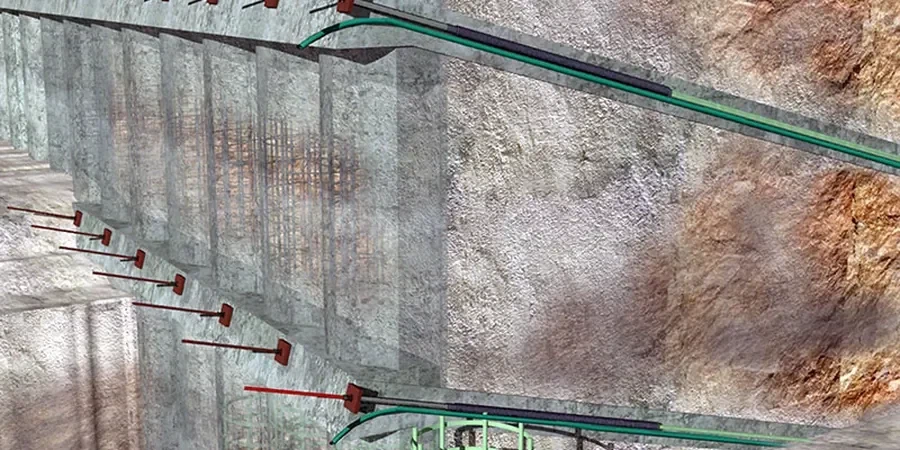
Canberra's topography isn't just about the lake and the Brindabellas. It's a city built on complex residual soils and deeply weathered bedrock, often with highly variable ground conditions within a single site. When a basement excavation in Civic hits unexpected decomposed granite, or a retaining wall in Belconnen needs to hold back expansive clay, standard reinforcement simply isn't enough. The anchor design has to account for the bond strength variability in the Canberra Formation siltstone and the influence of reactive soils on long-term tendon performance. Test pits provide the first clear look at that shallow profile, confirming where rockhead actually sits before any anchor drilling begins. Our approach treats each anchor as a critical load-transfer element, designed from the ground up using site-specific parameters.
A ground anchor is only as reliable as the bond zone geology it engages. In Canberra, that zone often changes within metres.
Q&A
How much does anchor design and testing cost for a typical Canberra project?
For a standard scope covering the design of a single anchor row and on-site proof testing, project fees typically range from AU$1,620 to AU$5,800. The final cost depends on the number of anchors, the required corrosion protection class, and the complexity of the site geology.
What is the difference between an active and a passive ground anchor?
An active anchor is prestressed and locked off against the structure immediately after installation, controlling movement from the start. A passive anchor, like a soil nail, is not tensioned; it develops its resisting force as the ground deforms. We specify active anchors where settlement-sensitive structures are adjacent to the excavation.
Why is corrosion protection so important in Canberra?
Local groundwater in areas like the Inner North can be slightly acidic and carry sulfates from weathering rock. Combined with the seasonal wet-dry cycles in the reactive clay profiles, this creates a moderately aggressive environment. A solid double-corrosion barrier prevents tendon degradation over the structure's design life.
How do you verify an anchor's capacity on site?
We conduct proof testing in accordance with AS 4678. A sacrificial anchor is loaded incrementally to 1.5 times the design load while recording displacement at each step. The creep rate over a fixed time period is measured to confirm the anchor sits within acceptable geotechnical limits before locking off production anchors.
What investigation is needed before designing an anchor system?
A targeted geotechnical investigation is essential. This includes boreholes with SPTs to define rock strength and weathering grades, combined with sampling for laboratory bond strength testing. The investigation must extend at least 3 metres beyond the proposed bond zone to ensure the anchor is founded in competent material.