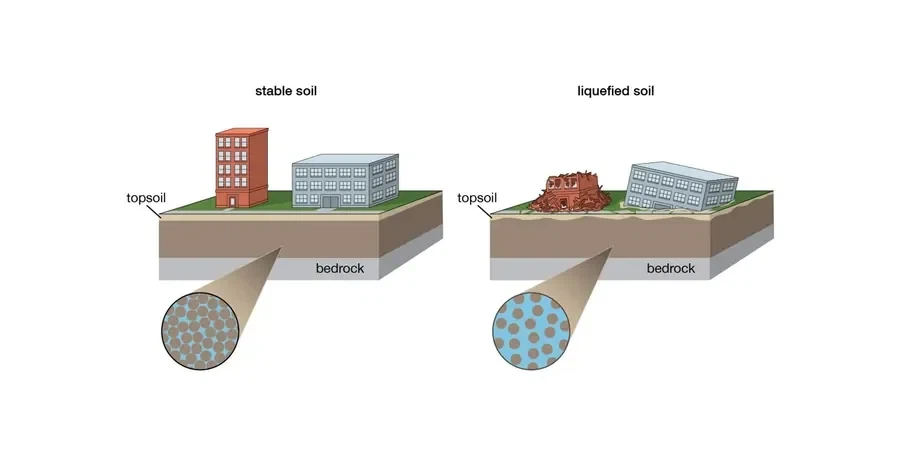
Canberra sits at roughly 580 metres above sea level, but elevation alone does not tell the full seismic story. The 1988 Tennant Creek earthquakes, though distant, prompted a rethink of intraplate hazard across Australia, and the ACT is not immune. Loose alluvial sands and silts along the Molonglo River corridor can lose strength under cyclic loading. That is why a site-specific soil liquefaction analysis matters here. We run field tests and lab programs to quantify the cyclic resistance ratio for each stratum. For deeper profiling, the work often pairs with CPT testing to capture continuous data in soft sediments, and we cross-check results with SPT drilling where gravels are present. The goal is a clear yes-or-no on liquefaction potential, not a generic report from a different postcode.
A soil can look stable under static load and still fluidise within seconds during a moderate earthquake. Our analysis measures that exact threshold.
Method and coverage
AS 1726 sets the framework for geotechnical site investigations in Australia, and we apply it rigorously across Canberra suburbs like Kingston, Fyshwick, and Belconnen. Saturated sandy layers below the water table are the primary target. We start with borehole logging, then run standard penetration tests to gather blow counts and disturbed samples. Grain size distribution from our lab, processed under the
grain size analysis protocol, tells us if the soil falls in the liquefiable range. Fines content and plasticity from
Atterberg limits further refine the susceptibility classification. For projects near Lake Burley Griffin, where groundwater is shallow, we also factor in the magnitude scaling factor from the 2018 National Seismic Hazard Assessment. The output is not a guess. It is a factor of safety against liquefaction for each critical layer.
Regional considerations
A common mistake we see is the assumption that Canberra is low-hazard, therefore no liquefaction check is needed. That shortcut fails on two fronts. First, the 1989 Newcastle earthquake showed that moderate magnitude events on unknown faults can still cause widespread soil damage. Second, buried paleochannels exist beneath parts of the ACT, filled with loose Holocene sediments that standard borelogs can miss. Skipping the analysis means the structural engineer designs for a bearing capacity that vanishes the moment pore pressure spikes. Post-liquefaction settlement can crack slabs, tilt footings, and rupture buried services. We map the liquefaction potential index across the buildable area so the design team knows exactly where Improvement or deep foundations are required. Ignoring this step is not conservative design; it is a liability.
Q&A
Does Canberra really need liquefaction analysis?
Yes, where site conditions match the criteria in AS 1726. The ACT has areas of loose alluvium and shallow groundwater. The national seismic hazard model assigns a non-zero PGA to the region. A screening study determines if further analysis is required.
How much does a soil liquefaction analysis cost in Canberra?
For a typical single-lot commercial or multi-residential site, the analysis ranges from AU$4,210 to AU$6,110 depending on the number of boreholes, lab tests, and depth of investigation. We provide a fixed-price proposal after reviewing the site geology.
What happens if liquefaction is found on my site?
The report recommends mitigation measures. Options include densification with vibro compaction, installation of stone columns, or switching to a deep foundation system like piles that bypass the liquefiable layer. We design the Improvement to meet the required factor of safety.