← Home · Laboratory

Atterberg Limits Testing in Canberra: Plasticity and Cohesive Soil Behaviour

Together, we solve the challenges of tomorrow.

EXPLORE →

The geology across the ACT basin changes abruptly within a few kilometres. A site in Belconnen might sit on deeply weathered Silurian volcanics, while a block in South Canberra overlies Quaternary alluvium from the Molonglo River floodplain. Both are cohesive soils, but they respond to water in completely different ways. The Atterberg limits test tells us exactly how plastic and sensitive those fines are before a footing goes in. Instead of guessing whether the clay will swell or shrink, the lab measures the moisture contents where the soil transitions from a semisolid to a plastic state, and finally to a liquid. For Canberra’s reactive clays, particularly around the Woden Valley and Tuggeranong suburbs, ignoring the plasticity index leads to slab damage within the first two drought cycles. We combine the Atterberg limits with a full grain-size distribution when the fines content exceeds 35%, giving the geotechnical engineer a complete picture of the material’s mechanical behaviour.

Plasticity index values above 25% in Canberra’s residual clays demand a site classification of H1 or higher under AS 2870.
Method and coverage

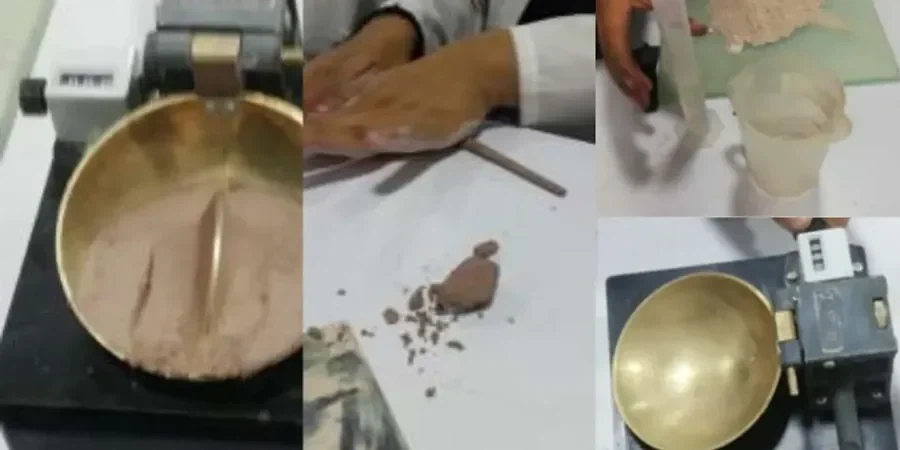
We often see site investigation reports that classify a Canberra clay as ‘firm’ based on a pocket penetrometer alone, but the Atterberg limits tell a different story. A soil with a liquid limit above 50% and a plasticity index over 20% will undergo significant volumetric change, even if it feels stiff when dry. Our lab runs the cone penetrometer method (AS 1289.3.9.1) for the liquid limit because it’s more reproducible than the Casagrande cup, especially on silty clays from weathered dacite found around Mount Ainslie. The plastic limit is determined by the 3 mm thread rolling method, and we cross-check results against the linear shrinkage test when AS 2870 site classification is required. For deep excavation projects near Lake Burley Griffin, where the water table fluctuates seasonally, we pair the Atterberg limits with slope-stability analysis to predict cut batter behaviour in high-plasticity residual soils.
Atterberg Limits Testing in Canberra: Plasticity and Cohesive Soil Behaviour
Technical reference image — Canberra

Regional considerations

AS 2870–2011 explicitly ties the site classification for residential slabs to the Atterberg limits and the reactivity of the founding clay. In Canberra, where the annual rainfall is only around 630 mm but evaporation exceeds it for most months, the moisture balance in the active zone swings hard between winter wetting and summer drying. A site classified as M based on a borehole log alone can behave like an H1 if the plasticity index was underestimated. The risk is asymmetric: the cost of an additional Atterberg limits test is negligible compared to the expense of underpinning a cracked slab on the south side of Red Hill or repairing a retaining wall that rotated because the backfill was placed wet of optimum. When the liquid limit is high and the liquidity index approaches 1.0, the soil loses strength rapidly under load, turning a routine excavation into a stability problem.

Need a geotechnical assessment?

Reply within 24h.

Email: contact@geotechnicalengineering1.co

Technical parameters

ParameterTypical value
Liquid Limit (LL)Cone penetrometer, AS 1289.3.9.1
Plastic Limit (PL)Thread rolling, AS 1289.3.2.1
Plasticity Index (PI)Calculated as LL − PL
Liquidity Index (LI)Calculated from in-situ moisture content
Linear Shrinkage (LS)AS 1289.3.4.1 (companion test)
Sample preparation425 µm sieved fraction, oven-dried
Reporting standardAS 1289.3.1.1, NATA-endorsed certificate

Complementary services

01

Basic Atterberg Suite (LL, PL, PI)

Cone penetrometer liquid limit, plastic limit by thread rolling, and computed plasticity index. Suitable for soil classification to AS 1726 and preliminary site assessment. Delivered with a NATA-endorsed report.

02

AS 2870 Reactivity Package

Atterberg limits plus linear shrinkage and a derived shrinkage index. Used by structural engineers to assign the site classification (A, S, M, H1, H2, E) for residential slab design per AS 2870. Includes a recommendation on the characteristic surface movement, ys.

Standards that apply

AS 1289.3.1.1 (Liquid limit – cone penetrometer), AS 1289.3.2.1 (Plastic limit – thread rolling), AS 1289.3.4.1 (Linear shrinkage), AS 2870–2011 (Residential slabs and footings – site classification)

Q&A

What is the typical cost of an Atterberg limits test in Canberra?

A basic Atterberg limits determination (liquid limit, plastic limit and plasticity index) usually ranges from AU$100 to AU$180 per sample, depending on whether the linear shrinkage companion test is included and the turnaround time requested.

How much soil is needed to run the Atterberg limits?

We need about 300 grams of material passing the 425 µm sieve. That usually means sending a 1 kg bag of the bulk sample so we can split, dry, and sieve it in the lab. For hand-augered samples from Canberra’s clay-rich suburbs like Downer or Watson, a well-sealed zip-lock bag is fine.

Why is the plasticity index so important for Canberra’s residential slabs?

The plasticity index directly controls how much a reactive clay shrinks and swells. AS 2870 uses the PI, together with the deep-seated moisture suction profile, to assign a site classification. In Canberra’s dry climate, a PI over 20% almost always triggers an H1 or H2 classification, requiring deeper edge beams and more reinforcement than a standard M-class slab.

Location and service area

We serve projects across Canberra and its metropolitan area.

View larger map