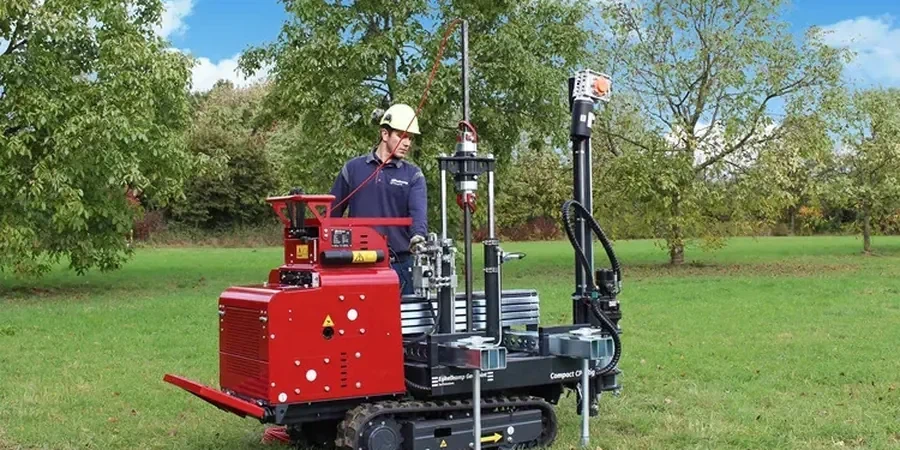
Canberra sits at roughly 580 metres above sea level on a plain framed by the Brindabella Ranges, and the soils beneath the city shift dramatically over short distances. A 2022 Geoscience Australia report confirmed that parts of the Molonglo Valley corridor contain deep alluvial sequences exceeding 30 metres, which makes continuous profiling essential before foundation design. The CPT test delivers exactly that. Rather than relying on disturbed samples, the cone penetration test records tip resistance, sleeve friction, and dynamic pore pressure in a single push, giving engineers a high-resolution log of subsurface layering. In Canberra’s mixed geology of weathered Silurian volcanics and Quaternary sediments, seismic microzonation studies depend on this level of detail to map site class boundaries accurately. The method reduces borehole count when paired with targeted drilling, and our ISO 17025 accredited lab processes the data to AS 1726 standards, ensuring every report meets the expectations of ACT planning authorities and structural reviewers.
CPT provides a continuous soil behaviour type log at 2 cm intervals, capturing thin layers that conventional SPT sampling routinely misses in Canberra's variable alluvial profiles.
Regional considerations
A medium-rise residential development planned along Northbourne Avenue encountered an unexpected soft clay lens at 9 metres depth during precast pile driving in 2021. The original desk study had relied on borehole logs spaced 25 metres apart, and none intercepted the feature. Pile set was inconsistent, and three units had to be re-driven after a settlement check triggered a stop-work order. A targeted CPT program was brought in afterward. Within two days, 14 soundings mapped the lens as a paleochannel roughly 18 metres wide, oriented parallel to Sullivans Creek. The data allowed the structural engineer to adjust pile toe levels and avoid costly re-driving across the remainder of the site. When you skip continuous profiling in Canberra’s buried stream channels, you risk exactly this scenario: differential settlement that emerges months after handover. The cone penetration test detects these soft inclusions because it never skips a depth increment, and the real-time pore pressure signal flags under-consolidated zones immediately.
Q&A
What depth can a CPT rig reach in Canberra’s geology?
Depth depends on soil density. In the medium-dense sands and stiff clays common across the Canberra plain, our 20-tonne truck-mounted rig typically reaches 25 to 30 metres before encountering refusal on weathered bedrock. In the loose alluvial fills of the Jerrabomberra wetlands, penetration may stop earlier if gravel lenses are present. We assess refusal against the AS 1289 criterion of 5 consecutive readings exceeding maximum thrust, not simply a predetermined depth.
How much does a CPT test cost in Canberra?
For a standard CPT sounding in the ACT, budget between AU$240 and AU$410 per location, with the final figure varying by mobilisation distance, number of soundings, and whether pore pressure dissipation or seismic modules are added. A typical single-house site with three soundings and an SBT report falls near the middle of that range. We provide a fixed-price quote after reviewing the site address and access conditions.
Does CPT replace boreholes for a Canberra development application?
CPT complements boreholes rather than fully replacing them under AS 1726-2017. The cone provides continuous stratigraphy and pore pressure data, but it does not retrieve soil samples for laboratory classification or strength testing. Most ACT planning approvals accept a combined program where CPT soundings are spaced between fewer boreholes, reducing overall investigation cost while improving lateral coverage. Our reports include a clear statement on investigation limitations so the design engineer can assess data confidence.