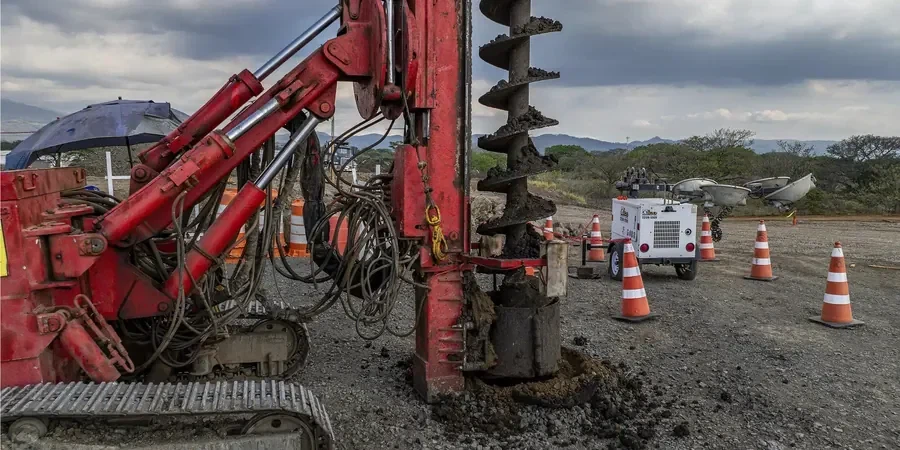
Canberra’s geology is a mosaic of deeply weathered Ordovician and Silurian rock, alluvial silty clay along the Molonglo corridor, and notorious Quaternary fill in older suburbs like Reid and Ainslie—where uncontrolled ash and builders’ rubble from the 1950s still turns up at four metres depth. The city sits on soft ground that swells or collapses with seasonal moisture change, and a 2018 Geoscience Australia survey mapped over 35 % of the ACT’s urban footprint as Class M or H reactive soil. When a conventional shallow footing runs out of capacity on these profiles, stone column design becomes the practical engineered solution: we place compacted gravel columns through the weak layer, transferring load to a stiffer bearing stratum while draining excess pore pressure. The approach works well under warehouses in Hume, multi-storey car parks in Belconnen, and any Canberra project where excavation and replacement would be too slow or too expensive. Because the ACT’s seismic hazard factor Z is 0.08–0.10 under AS 1170.4, the improved ground must still meet post-vibration settlement limits, which we verify with CPT testing before finalising the column grid.
On Canberra's reactive clays, a well-designed stone column grid converts a marginal Class H site into a buildable platform without deep piling — and drains the ground at the same time.
Method and coverage
The rigs we mobilise across Canberra are typically top-feed vibroflots suspended from a 40-tonne crawler crane, equipped with a 130–180 kW electric or hydraulic vibrator running at 30–50 Hz — enough to penetrate stiff residual clay and weathered dacite floaters that appear unpredictably across the southern suburbs. A water-jetting system assists penetration through the dry, overconsolidated silts common on the slopes of Mount Ainslie, while bottom-feed units are used when working inside existing warehouses in Fyshwick where overhead clearance is tight and spoil removal must be kept to a minimum. The stone itself is a clean, angular 25–75 mm crushed aggregate sourced from local Canberra quarries such as the Mugga Mugga metasediment operation; it must meet the AS 4678 grading envelope for free-draining columns, with a fines content below 5 % and a Los Angeles abrasion value under 30 to resist crushing during compaction. Each column is built from the bottom up in controlled 0.5–1.0 m lifts, with power consumption and amperage logs cross-checked against the design target of at least 45 amps for dense bearing sand — a threshold we have calibrated over dozens of Canberra jobs where the natural ground below the Molonglo floodplain alluvium sits at 6–9 metres.
Regional considerations
A mid-rise residential block on the old landfill boundary in Kingston was showing differential settlement of 40 mm within eighteen months of handover — cracks tracking diagonally through the brick veneer and slab joints opening 3 mm across. The original investigation had stopped at five metres, missing a pocket of saturated newspaper ash 2.5 metres thick that consolidated unevenly under the eastern wing. We designed a 0.9 m diameter stone column grid at 2.2 m centres, installed through the slab using a low-headroom bottom-feed rig that worked inside the occupied ground floor car park. Vibro-replacement densified the ash layer and created a composite ground mass with an equivalent modulus over 25 MPa, stopping further movement within the first wet-dry cycle. The lesson in Canberra is simple: if the borelog ends in fill and the water table fluctuates inside the zone of influence, settlement will not stabilise on its own — stone columns need to reach the residual soil or rock below, and the design must account for lateral strain under seismic load per AS 4678 Section 6.
Q&A
What types of Canberra soil conditions benefit most from stone columns?
In our experience across the ACT, stone columns deliver the strongest cost-benefit on soft alluvial silty clay along the Molonglo River corridor, loose uncontrolled fill in older suburbs, and the upper weathered zone of the Canberra Formation where undrained shear strength is below 30 kPa. They also work well on reactive clay sites classified as Class H1-D, where they reduce heave by creating a free-draining composite ground that interrupts the capillary rise path.
How much does stone column design and installation cost in Canberra?
For a small commercial slab or townhouse group in the ACT, stone column design and installation typically falls between AU$2,460 and AU$8,440 depending on column depth, grid density, stone haulage distance from local quarries, and whether a bottom-feed rig is needed for low-headroom access. A full feasibility study and post-installation CPT verification programme is included in that range for standard projects.
Do stone columns work under seismic loading in Canberra?
Yes, provided the design accounts for the ACT seismic hazard factor Z of 0.08–0.10 under AS 1170.4. Stone columns add shear resistance to soft ground and drain excess pore pressure during cyclic loading, which reduces the liquefaction risk in loose saturated sands. We model the improved ground as a composite material and check lateral strain and bearing capacity under the seismic load case per AS 4678 Section 6.
What verification testing do you carry out after stone column installation?
We specify CPT soundings through the centre of selected columns and in the soil between columns to confirm that the installed grid meets the design modulus and density targets. On larger Canberra projects we may add plate load tests on the improved platform and multi-channel surface wave testing (MASW) to map the composite shear-wave velocity profile before structural works begin.