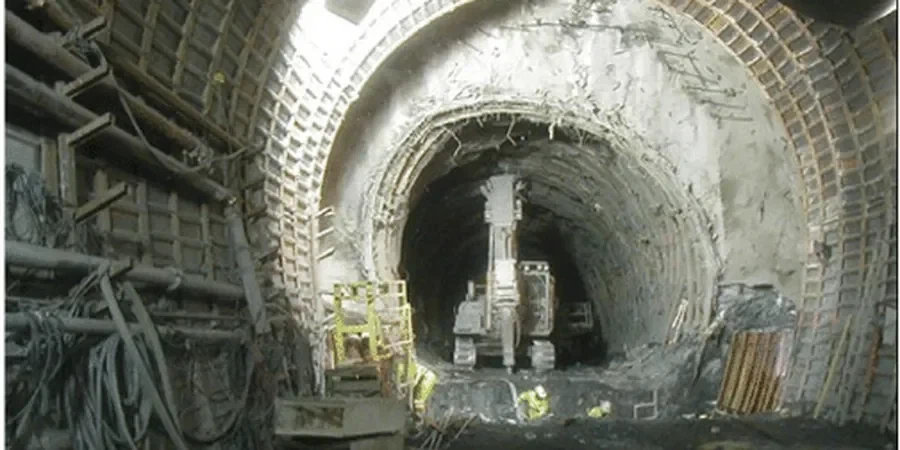
Canberra's landscape, shaped by the ancient Murrumbidgee River and its tributaries, presents a unique challenge for underground construction. The city sits on a deep sedimentary basin, which means that beneath the planned streets and iconic roundabouts, you are often dealing with Quaternary alluvium rather than solid rock. For any tunnel project, from stormwater diversions to utility passages, a standard rock mechanics approach simply does not cut it. The high water table in districts like Belconnen and the variable clay deposits across the Molonglo Valley demand a rigorous and site-specific geotechnical analysis for soft soil tunnels. Before a single meter is bored, the behaviour of these saturated, unconsolidated sediments must be fully understood to prevent face collapse or excessive surface settlement. Our technical team integrates local geological knowledge with advanced laboratory testing to characterise these soft-ground conditions, ensuring the design accounts for the ground's low stand-up time and squeezing potential from the very first conceptual model.
Tunneling through Canberra's Quaternary alluvium requires managing a groundwater table that can be less than 3 meters below the surface, making face stability the primary geotechnical design constraint.
Method and coverage
The weathered mudstone and siltstone of the Canberra Formation, often encountered beneath the alluvial cover, can transition abruptly into residual clay zones that behave like a soft soil during excavation. A defining characteristic of soft-ground tunnelling here is the management of groundwater inflow and the resulting reduction in effective stress. The material often exhibits a plasticity index above 20%, as determined through
atterberg limits testing, which directly impacts the selection of the tunnel boring machine's cutting head and face support pressure. Equally critical is assessing the undrained shear strength profile. When tunneling through the lake deposits near Lake Burley Griffin, a comprehensive
triaxial testing program is essential to calibrate constitutive soil models used in finite element analysis. The analysis must also consider the anisotropic permeability of layered silts and clays, a factor that frequently dictates the spacing and depth of pre-excavation drainage arrays to keep the excavation face stable and dry.
Regional considerations
The geotechnical risk profile for soft soil tunneling varies markedly between the established inner north of Canberra and the newer development corridors in the Molonglo Valley. In the inner north, the risk is heavily skewed toward settlement-induced damage to existing infrastructure; the ground loss above a shallow tunnel can distort the foundations of adjacent buildings if the support pressure is not meticulously balanced. Conversely, in the open fields of the Molonglo Valley, the primary hazard shifts toward face instability and blowouts, driven by pockets of high pore water pressure trapped within discontinuous sand lenses. The transition zone between the residual clay and the underlying weathered rock is particularly treacherous, often acting as a preferential flow path for groundwater. A failure to detect these interfaces during the site investigation phase is the most common cause of cost overruns and construction delays in Canberra's soft-ground tunneling projects.
Q&A
What is the typical cost range for a geotechnical analysis for a soft soil tunnel in Canberra?
The investment typically ranges from AU$6,960 to AU$27,190. This depends on the length of the tunnel alignment, the number of required boreholes, and the complexity of the laboratory testing program. A site in the deep alluvial deposits of the Majura Valley, for instance, will require a more extensive investigation than a short crossing through a shallow residual clay profile.
Which Australian standards govern the geotechnical design of soft-ground tunnels?
The primary standard for site investigations is AS 1726:2017. For structural aspects, AS 4678–2002 applies to earth-retaining structures, and AS 5100.3:2017 is relevant for tunnel support systems. The Austroads Guide to Tunnelling also provides a comprehensive framework for the planning, design, and construction of road tunnels in Australia.
How do you account for the high groundwater table in Canberra's lake areas when planning a tunnel?
We install vibrating wire piezometers in dedicated boreholes to monitor pore water pressure fluctuations over several tidal and seasonal cycles. This data is fed directly into a coupled flow-deformation analysis. The goal is to design a face support pressure that is high enough to prevent groundwater inflow but not so high that it causes hydrofracturing of the surrounding clay.
What is the most significant geotechnical hazard for tunneling in the Canberra Formation?
The rapid weathering profile is the key hazard. Competent siltstone can degrade to a soft, expansive clay over a vertical distance of just a few meters. This creates a mixed-face condition at the tunnel horizon, where the bottom of the face is in soft soil and the crown is in hard rock. This scenario requires careful selection of the excavation method and cutterhead tools to manage uneven abrasion and face instability.