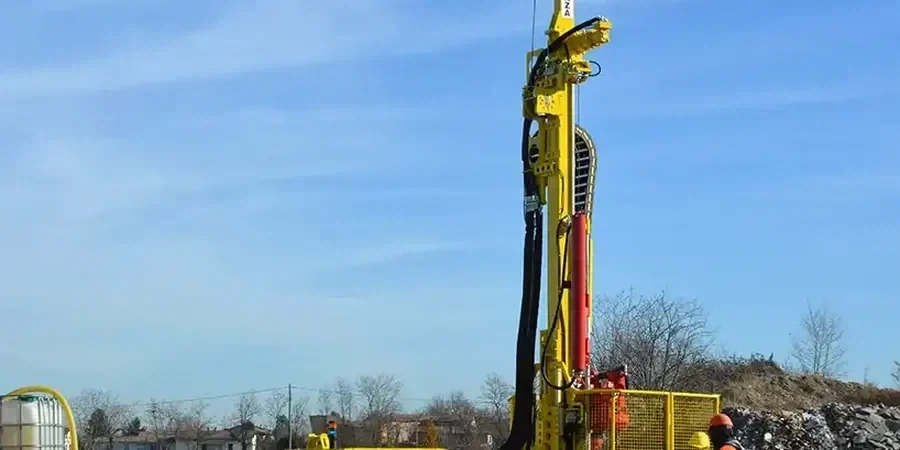
Canberra's development from a planned garden city into a modern urban centre has placed increasing demands on its underlying geology. Much of the city sits on the Canberra Formation — steeply dipping, weathered siltstone and sandstone — while the major valleys contain deep Quaternary alluvium and colluvium. In suburbs like Gungahlin and Molonglo Valley, where greenfield development continues, the SPT (Standard Penetration Test) has become the default method for characterising these variable profiles. Our team has worked extensively with the local geology, and we know that blow counts can shift dramatically within a single metre of drilling when you cross from residual soil into decomposed rock. Complementing the SPT with a grain-size analysis helps distinguish silty sand from clayey gravel in these transitional zones, which directly influences bearing capacity calculations.
In Canberra's weathered siltstone, SPT blow counts can double within 500 mm of depth — relying on averaged N-values without geological context is a design risk.
Q&A
What depth do you typically drill for SPT in Canberra's geology?
Depth depends on the project, but for residential and low-rise commercial foundations in Canberra we typically drill to 6–10 metres, or until we encounter refusal in the weathered rock of the Canberra Formation. For deeper infrastructure like multi-level basements near Civic, we extend to 20–30 metres. The key is reaching competent material — in areas like Belconnen that means penetrating through the alluvial clays into the underlying siltstone.
How much does an SPT investigation cost for a standard residential block?
For a typical residential site investigation in Canberra with two boreholes to 6 metres, including NATA-accredited laboratory testing and a geotechnical report, you're looking at AU$870 to AU$1,240 depending on access conditions and whether we need a track-mounted rig for sloping blocks in suburbs like Aranda or O'Connor.
How long does it take to get the SPT results and report?
Fieldwork for a standard investigation is usually completed in one day. Laboratory testing adds 5–7 working days, and the interpretative report follows within 3–5 working days after lab data is finalised. A full package from drilling to report delivery typically takes two to three weeks.
Do you handle the Dial Before You Dig (DBYD) process for Canberra sites?
Yes, we manage the DBYD service enquiry and coordinate with Access Canberra for any required permits before mobilising the drill rig. Canberra has a dense network of underground services in established suburbs, and we won't put a borehole down without confirmed clearances.