← Home · Laboratory

Triaxial Testing in Canberra | Advanced Soil Strength Parameters

Together, we solve the challenges of tomorrow.

EXPLORE →

The ground story changes fast when you cross from the Ordovician sediments of Civic toward the deeply weathered porphyry around Red Hill. In Civic, you might hit Pittman Formation siltstone at three metres; move south and the profile can flip to a stiff residual clay band over extremely weathered dyke rock. That contrast means the effective friction angle and drained cohesion you assume for one side of Canberra simply will not hold for the other. We see it every week when site investigation data arrives. A CPT test gives a continuous sleeve friction trace that flags these transitions, but it cannot deliver phi-prime or c-prime directly. For that, you need a multi-stage triaxial programme run on undisturbed tube samples recovered from the exact stratum you propose to load. Our Canberra team runs both isotropically consolidated undrained tests with pore pressure measurement and consolidated drained shear stages, tailoring the stress path to match the construction sequence you have on the drawing board.

Drained triaxial parameters measured at 0.005 mm/min on Canberra Formation clay can halve the design friction angle compared to a quick undrained run—never skip the consolidation stage.

Method and coverage

AS 1726:2017 makes it clear: derived parameters must come from test methods that reproduce the field drainage condition. Canberra’s residual profiles are notorious for holding negative pore pressures above the water table; a quick undrained test on an unsaturated specimen can give a misleadingly high undrained shear strength that vanishes the moment the site gets wet. We saturate every specimen to Skempton’s B-value of at least 0.95 before we start shearing. For drained stages we stick to displacement rates slow enough to keep excess pore pressure below 2 kPa—often 0.005 mm/min or slower on clay-rich samples from the Canberra Formation. Where the project demands a full failure envelope, we run three specimens at different confining pressures and plot Mohr circles that comply with the curvature limits in AS 1726 Appendix C. Pairing the triaxial data with Atterberg limits lets us cross-check the plasticity index against published correlations for the weathered Monaro Group soils, giving the design engineer a second line of evidence before locking in the friction angle for bearing capacity or slope work.
Triaxial Testing in Canberra | Advanced Soil Strength Parameters
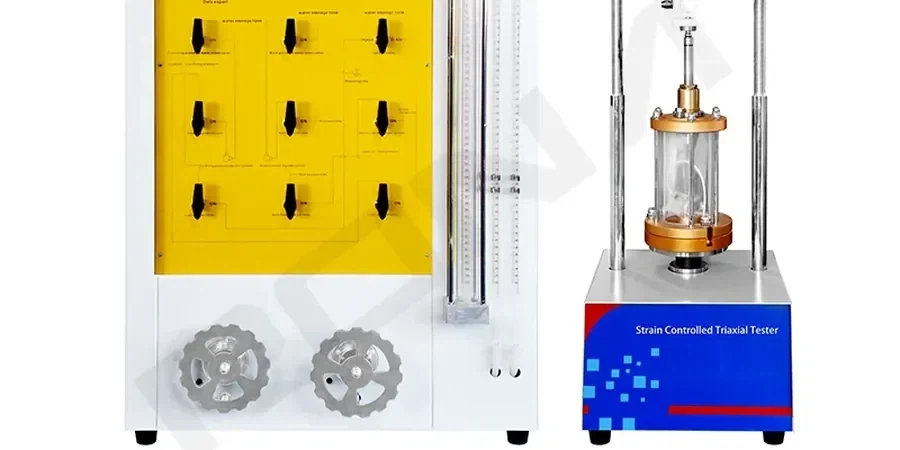
Technical reference image — Canberra

Regional considerations

Canberra sits at roughly 580 metres elevation on a landscape that has been tectonically quiet for a long time, but the 1989 Newcastle earthquake—magnitude 5.6 and 400 km away—reminded every geotechnical engineer in the ACT that intraplate shaking is real and it travels efficiently through the Palaeozoic basement. The AS 1170.4 hazard factor for Canberra is not zero, and when you are pushing a shallow footing into a residual clay with a plasticity index above 25, the undrained strength you pick from a single triaxial test can make the difference between a safe bearing capacity and a post-seismic settlement problem. We have seen sites where the top three metres of Canberra Formation clay lost more than 40% of its peak deviator stress under cyclic triaxial loading simulating a 500-year return period event. That is not a scare story—it is laboratory data. The liquefaction assessment is usually run separately with SPT or CPT triggers, but when the fines content exceeds 35% we recommend a cyclic triaxial check to measure pore pressure build-up directly on undisturbed specimens, particularly for critical infrastructure in the Molonglo Valley corridor.

Need a geotechnical assessment?

Reply within 24h.

Email: contact@geotechnicalengineering1.co

Technical parameters

ParameterTypical value
Specimen diameter50 mm (standard) / 38 mm (tube samples)
Confining pressure range50 kPa to 1200 kPa (pneumatic servo)
B-value saturation target≥ 0.95 (Skempton criterion)
Drained shear rate0.002 – 0.010 mm/min (AS 1726 compliant)
Pore pressure transducer accuracy±0.25% full scale (3 MPa range)
Failure criterion reportedPeak deviator stress / residual state / 20% axial strain
Mohr-Coulomb outputc’ (kPa) and φ’ (degrees), R² ≥ 0.92

Complementary services

01

Consolidated Undrained Triaxial with Pore Pressure (CUPP)

Three-stage isotropic consolidation followed by undrained shear at 0.05 mm/min. We track excess pore pressure throughout and report total and effective stress Mohr circles. Ideal for short-term stability checks on saturated Canberra Formation clays and for projects where the construction rate exceeds drainage capacity.

02

Consolidated Drained Triaxial (CD) and Multi-Stage Envelope

Single-specimen or three-specimen drained shear at rates calibrated to the soil permeability. We deliver c’ and φ’ with linear regression over three confining stresses. Applied to footings on residual siltstone, cut slopes in weathered porphyry, and any situation where long-term drained conditions govern the design.

Standards that apply

AS 1726:2017 Geotechnical site investigations, AS 1289.6.4.1/6.4.2 Triaxial compression tests, AS 4678:2002 Earth-retaining structures (parameter selection), AS 1170.4:2007 Structural design actions – Earthquake actions

Q&A

How long does a triaxial test programme take from sample delivery to report in Canberra?

A standard three-specimen CUPP suite takes seven to ten working days once the samples have been extruded and trimmed. Consolidated drained stages add roughly three to five working days per specimen because of the slow shear rate required for clay-rich soils. We schedule the work around your design programme and can usually accommodate urgent single-specimen runs inside four working days if the saturation and consolidation stages go smoothly.

What is the typical cost range for a triaxial test programme on Canberra Formation soils?

Depending on the number of specimens and the type of shear stage, a triaxial programme generally falls between AU$3,330 and AU$3,920. That covers specimen trimming, saturation checks, consolidation, shear, and a full interpreted report with Mohr-Coulomb parameters. Multi-stage drained envelopes and cyclic triaxial runs are quoted separately based on your project specification.

Which AS 1289 method do you follow for triaxial testing?

We follow AS 1289.6.4.1 for the consolidated undrained triaxial compression test with pore pressure measurement, and AS 1289.6.4.2 for the consolidated drained triaxial compression test. Both methods are cited inside AS 1726:2017 as the primary routes to derive effective stress strength parameters for geotechnical design in Australia.

Can you run triaxial tests on weathered rock core from Canberra sites?

Yes, provided the core pieces are at least 80 mm long and can be trimmed to a 2:1 height-to-diameter ratio without fracturing. For extremely weathered porphyry or siltstone we often use a membrane with filter-paper side drains and run drained stages at confining pressures that bracket the estimated in-situ horizontal stress. The resulting failure envelope gives a reliable lower-bound strength for socket design and retaining wall analysis.

What additional geotechnical tests should I combine with a triaxial programme for a Canberra foundation design?

We recommend pairing the triaxial data with a particle size distribution test to check gravel and fines fractions, and with Atterberg limits to confirm the plasticity index. Where the water table is shallow or the site sits in a drainage line, an in-situ permeability test helps calibrate the consolidation rate. For seismic design, a cyclic triaxial or a liquefaction assessment using SPT or CPT data adds the dynamic strength parameters needed for AS 1170.4 compliance.
Location and service area

We serve projects across Canberra and its metropolitan area.

View larger map